Perovskite solar cell with reduced interfacial strain
Interface strains and lattice distortion are inevitable issues during perovskite crystallization. Silane as a coupling agent is a popular connector to enhance
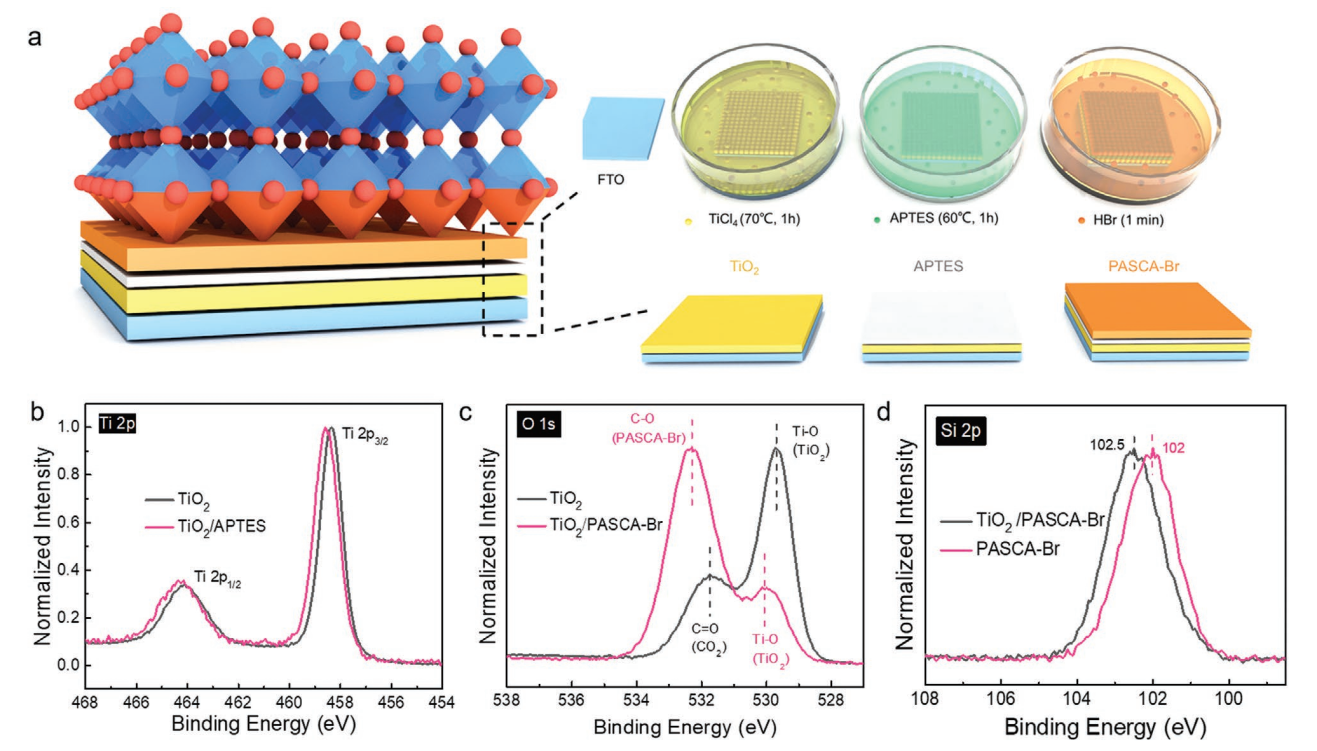
the compatibility between inorganic and organic materials in semiconductor devices. Herein, a protonated amine silane coupling agent (PASCA-Br)
interlayer between TiO2 and perovskite layers is adopted to directionally grasp both of them by forming the structural component of a lattice unit.
The pillowy alkyl ammonium bromide terminals at the upper side of the interlayer provide well-matched growth sites for the perovskite, leading
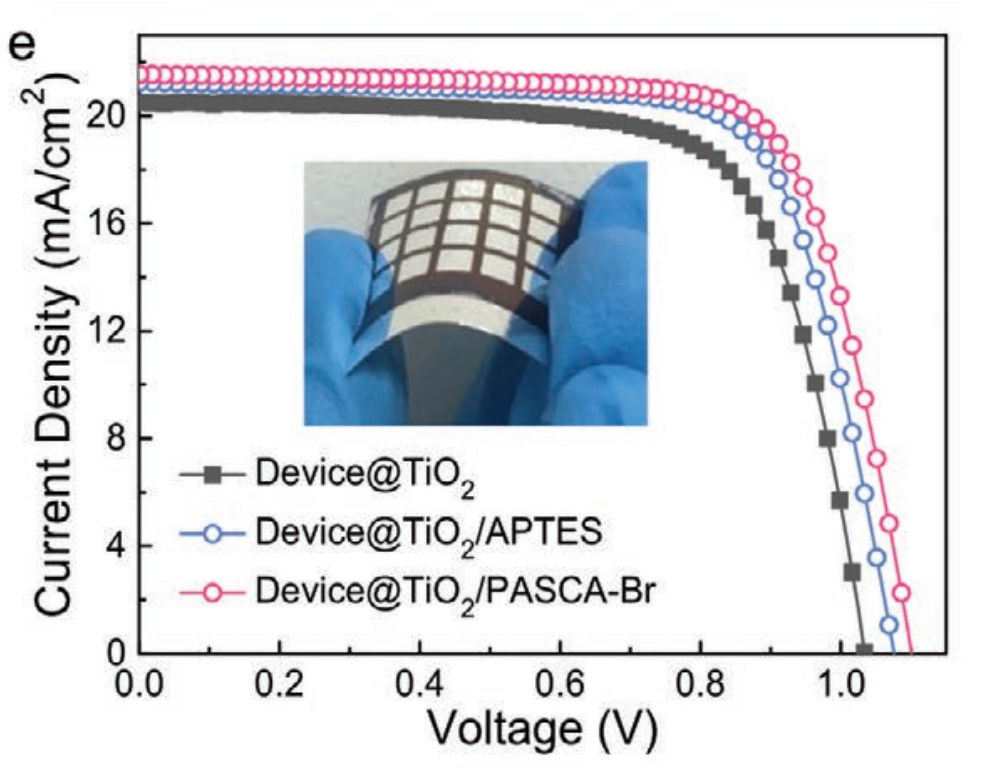
to mitigated interface strain and ensuing lattice distortion; meanwhile, its superior chemical compatibility presents an ideal effect on healing the undercoordinated Pb atoms and halogen vacancies of bare perovskite crystals. The PASCA-Br interlayer also serves as a mechanical buffer layer, inducing less
cracked perovskite film when bending. The developed molecular-level flexible interlayer provides a promising interfacial engineering for perovskite solar
cells and their flexible application.
- S. C. -C. Zhang, S. Yuan, Y-H. Lou, Q-W Liu, M. Li, H. Okada, and Z-K. Wang, "Perovskite Films with Reduced Interfacial Strains via a Molecular‐Level Flexible Interlayer for Photovoltaic Application", Adv. Mater. 2020, 2001479 (2020). DOI: 10.1002/adma.202001479.
Copyright ©
Electron Device Laboratory, University of Toyama.
All rights reserved.