Solution-processed low-molecular-weight OLED
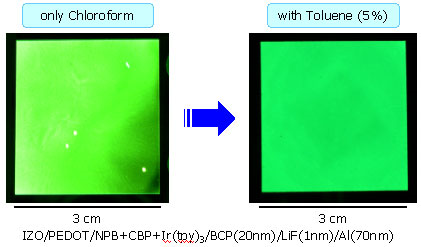
Two types of common device fabrication techniques are evaporation- and solution-processes.
Merits of solution-process are easy fabrication, large-area production and higher-material saving and it is expect for lower production cost.
In conventional solution-process, polymer material was used.
However, top device performance is inferior to that of small molecule and difficulty of purity, non-uniform conduction and emission arises from film uniformity, and lower durability are still issue.
On the other hand, OLED using small molecule has higher purity, higher luminance and efficiency, good color reproducibility and longer lifetime.
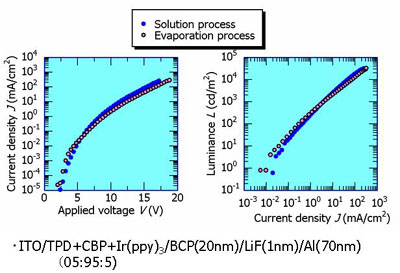
If solution process is carried out using small molecule, identical characteristics using evaporation device characteristics will be realized.
In this time, durability tests of solution-processed organic electrophosphorescent devices (SP-PHOLEDs) with small organic molecules have been investigated.
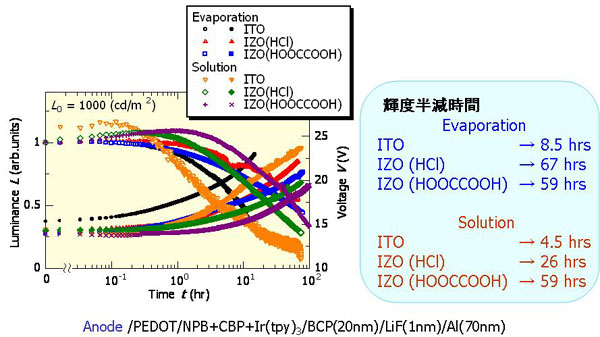
By using poly(ethylene dioxythiophene)/poly(styrene sulfonate) (PEDOT) as a buffer layer and indium zinc oxide (IZO) as an anode, device durability was markedly improved.
The lifetime of the SP-PHOLED, defined as half-luminous at an initial luminance of 1,000 cd/m2, was 60 h, this vale is almost identical to that of evaporation OLED.
This solution-process could be applied for the IJP-OLED.
- "Durability Test of Solution-Processed Organic Electrophosphorescent Devices with Small Organic Molecules", M. Ooe, S. Naka, H. Okada and H. Onnagawa, Jpn. J. Appl. Phys. 45 (1A) pp.250-254 (2006).
Copyright ©
Electronic Material and Devices Engineering Laboratory, University of Toyama.
All rights reserved.