富山大学 学術研究部理学系 特命助教
Assistant Professor (Project), Faculty of Science, University of Toyama
RESEARCH
研究内容 / Research
海洋は気候システムの重要な構成要素です。私の研究では、海洋循環や炭素循環を中心とする海洋過程が気候変動に果たす役割を、数値モデリングとデータ解析を用いて理解することを目指しています。
The ocean is a fundamental component of the climate system. My research aims to understand the role of oceanic processes, particularly ocean circulation and the carbon cycle, in climate variability and change through numerical modeling and data analysis.
MAIN RESEARCH TOPICS
主な研究テーマ / Main Research Topics
01
海洋循環と炭素循環
Ocean Circulation and the Carbon Cycle
全球海洋深層循環と海洋炭素吸収の関係
Links between global deep-ocean circulation and ocean carbon uptake
氷床融解水が海洋循環・気候・物質循環へ与える影響
Impacts of ice-sheet meltwater on ocean circulation, climate,
and biogeochemical cycles
海洋に取り込まれた炭素の輸送経路と長期的な行方
Transport pathways and the long-term fate of carbon taken up by the ocean
溶存有機物、微量元素、化学トレーサーの循環
Cycling of dissolved organic matter, trace elements, and chemical tracers
気候変化に伴う北西太平洋・日本海の海洋循環、炭素循環、海洋環境の変動
Changes in ocean circulation, carbon cycling, and marine environments
in the northwestern Pacific and the Sea of Japan under a changing climate
02
気候変動と海洋生態系
Climate Change and Marine Ecosystems
温暖化・酸性化・貧酸素化・生物生産の将来変化
Future changes in warming, acidification, deoxygenation,
and biological production
海洋生態系のティッピングポイントと極端現象
Tipping points and extreme events in marine ecosystems
植物プランクトン、栄養塩、炭素循環を表す生態系モデルの改良
Improvement of ecosystem models representing phytoplankton,
nutrients, and carbon cycling
海洋環境変化がサンゴ礁生態系へ与えるストレスと炭素循環との相互作用
Interactions between environmental stress on coral reef ecosystems
and the ocean carbon cycle
人間活動に伴う大気・河川からの栄養塩負荷の影響評価
Assessment of atmospheric and riverine nutrient inputs
associated with human activities
03
古気候・古海洋
Paleoclimate and Paleoceanography
氷期-間氷期サイクルにおける大気中 CO
2
変動の要因
Drivers of atmospheric CO
2
variations during
glacial?interglacial cycles
ハインリッヒイベントやダンスガード・オシュガーイベントに代表される
急激な気候変動と、海洋深層循環の不安定性
Abrupt climate changes, including Heinrich and
Dansgaard?Oeschger events, and the instability
of deep-ocean circulation
海水準・大陸配置・海底地形・海峡の変化が
海洋循環と物質循環へ与える影響
Effects of changes in sea level, continental configuration,
seafloor topography, and ocean gateways on ocean circulation
and biogeochemical cycles
白亜紀・始新世・中新世など、過去の温暖気候における
海洋循環・炭素循環・気候の相互作用
Interactions among ocean circulation, the carbon cycle, and climate
during past warm periods, including the Cretaceous, Eocene, and Miocene
新原生代のスノーボールアースにおける全球凍結、
海洋循環、炭素循環と気候回復過程
Global glaciation, ocean circulation, the carbon cycle,
and climate recovery during Neoproterozoic Snowball Earth events
04
沿岸海洋と陸海連環
Coastal Oceans and Land?Ocean Interactions
河川・地下水を通じた栄養塩・炭素の輸送
Riverine and groundwater transport of nutrients and carbon
陸域から沿岸海洋への物質輸送とその環境影響
Material transport from land to the coastal ocean
and its environmental impacts
沿岸域の富栄養化・酸性化・貧酸素化
Coastal eutrophication, acidification, and deoxygenation
海底堆積物過程と沿岸炭素収支
Sediment processes and coastal carbon budgets
高解像度沿岸海洋モデルの開発
Development of high-resolution coastal ocean models
The ocean is a vast reservoir that stores and transports heat, water, nutrients, and carbon on a global scale. Deep-ocean circulation connects the world’s oceans over centuries to millennia, sustaining marine ecosystems and regulating Earth’s climate. The ocean is also an important sink for anthropogenic carbon dioxide, although this uptake is closely linked to environmental changes such as ocean acidification.
The ocean does not operate in isolation. Rivers and groundwater transport nutrients and carbon from land to the sea, while meltwater from ice sheets may alter seawater density and ocean circulation. It is therefore essential to view the atmosphere, ocean, land, ice sheets, and ecosystems as an interconnected Earth system.
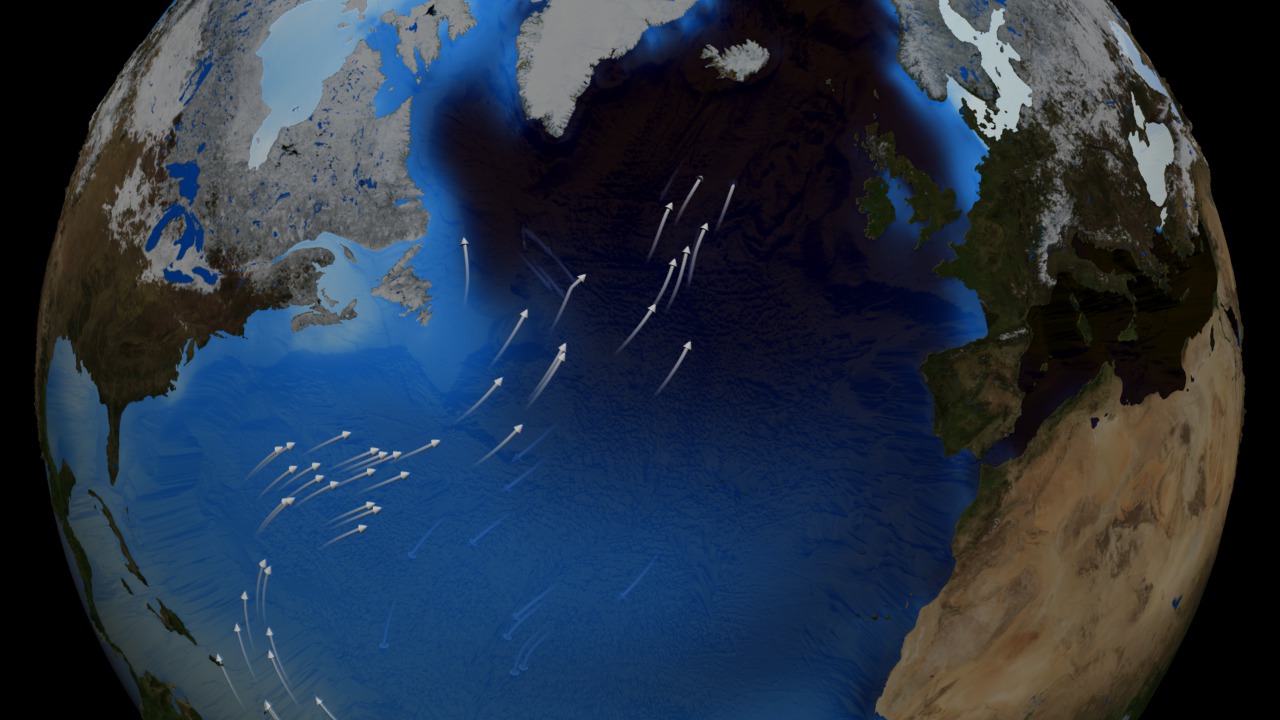
OCEAN CIRCULATION
全球の熱塩循環(海洋深層大循環)の可視化。出典:NASA/Goddard Space Flight Center Scientific Visualization Studio, “The Thermohaline Circulation -- The Great Ocean Conveyor Belt” (2009)。
原資料
We translate the equations governing atmospheric and oceanic motion, biogeochemical cycles, and ecosystem processes into computer programs and use them to build climate and ocean models. By combining numerical experiments on supercomputers with analyses of observational and model data, we seek to understand the present climate, reconstruct past climates, and project future changes.
Our laboratory investigates questions about the ocean and climate primarily through numerical simulations and data analysis. We value each student's interests and pace of development, and provide close guidance and discussion in a small-group environment to help students become independent researchers.
These transferable skills are valuable not only for graduate study and careers in research and education, but also for professions in information technology, finance, environmental and energy industries, consulting, manufacturing, public service, and many other fields.
Daily research activities include reading scientific papers, developing research questions, conducting numerical experiments and data analyses, discussing results, and preparing presentations and theses. Students also participate in seminars, conferences, field activities, and laboratory events as appropriate.
Ocean and climate science advances through collaboration across countries and disciplines. Our laboratory participates in international collaborations and research projects, and students may have opportunities to interact with overseas researchers and present their work internationally.
Advanced programming experience or specialized knowledge of oceanography is not required when joining the laboratory. Students develop the necessary knowledge and skills step by step through their research.
よくある質問
Frequently Asked Questions
プログラミング経験は必要ですか? / Is programming experience required?
Programming experience is not required. Students learn Unix Shell, Fortran, Python, and other tools step by step as needed for their research. Those with prior experience can build on their existing skills, while beginners are supported in developing a solid foundation.
数学や物理が得意でないと難しいですか? / Do I need to be strong in mathematics and physics?
Research in our laboratory involves mathematics and physics, but you are not expected to master everything from the beginning. What matters most is a willingness to learn the necessary concepts and apply them to your own research questions.
Our laboratory does not have a strict core-time policy. Instead, we encourage students to manage their own schedules while taking responsibility for their research. Students are expected to participate actively in seminars, meetings, and research discussions. The amount of time spent in the laboratory naturally depends on each student's research stage and project.
研究テーマはどのように決めますか? / How is a research topic selected?
Research topics are selected through discussions between students and the supervisor, taking into account each student's interests, academic background, and the available models and datasets. We also welcome students who wish to explore their own research ideas related to the atmosphere, ocean, land, ice sheets, and ecosystems.
海洋観測や研究航海に参加できますか? / Can students join oceanographic observations or research cruises?
Depending on the research project and available opportunities, students may participate in oceanographic observations, field courses, or research cruises. While some projects involve field observations, others focus primarily on numerical modeling and data analysis.
大学院へ進学した方がよいですか? / Should I go on to graduate school?
Graduate school is not the only career path, and the best choice depends on your interests and future goals. However, if you would like to deepen your research experience and develop advanced expertise in Earth system science, data analysis, and scientific communication, graduate study provides an excellent opportunity for further growth. We are happy to discuss your future plans and help you choose the path that best matches your goals.
大学院生向けの奨学金や経済的支援はありますか? / Are scholarships or financial support available for graduate students?
Graduate students may apply for scholarships and financial support provided by the university, JSPS, JST, and private foundations. In particular, doctoral students often have opportunities to receive fellowships or other forms of financial support. Since available programs vary from year to year, we are happy to advise students on suitable opportunities and application procedures.
卒業後にはどのような進路がありますか? / What career paths are available after graduation?
Our graduates pursue a wide range of career paths, including graduate study, research and education, information technology, finance, environmental and energy industries, consulting, manufacturing, and public service. The analytical, computational, communication, and problem-solving skills developed through research are valuable in many professional fields.