Research
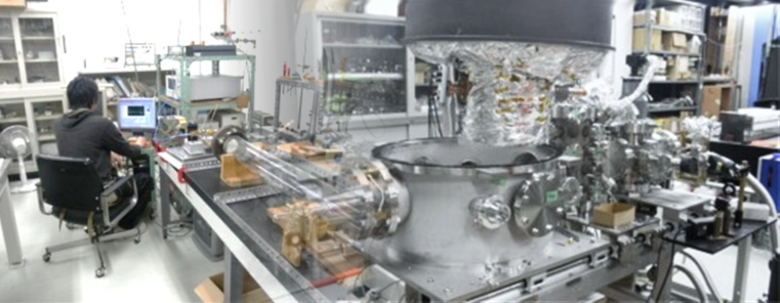
The Microwave Laboratory, Physics Program, Faculty of Science, University of Toyama, conducts research on the interaction between electromagnetic radiation and molecules. Our research includes microwave spectroscopy, spectroscopy of molecules in space and planetary atmospheres, near-infrared spectroscopy of tritiated water, control of molecular motion using microwave fields, and high-resolution laser spectroscopy in the visible region.
Spectroscopy of Molecules in Space
Dense molecular clouds in interstellar space emit numerous spectral lines in the microwave and millimeter-wave regions. Many of these lines have not yet been assigned to specific molecules.
Our laboratory performs high-resolution laboratory spectroscopy to provide accurate spectroscopic data for identifying molecules observed in space. We are particularly interested in molecules exhibiting internal rotation, including:
- Methyl formate (HCOOCH3)
- Ethyl methyl ether (CH3CH2OCH3)
- Methanol (CH3OH)
- Dimethyl ether ((CH3)2O)
Our spectroscopic data are applied to astronomical observations with the 45-m radio telescope at Nobeyama Radio Observatory and the Atacama Large Millimeter/submillimeter Array (ALMA).
Control of Molecular Motion Using Microwave Fields

Laser cooling has enabled ultracold atomic gases to be trapped and manipulated with extraordinary precision. Applying similar techniques to molecules, however, remains much more challenging because of their complex internal structure.
Our laboratory develops methods for focusing, decelerating, and trapping polar molecules using intense microwave fields generated in superconducting resonant cavities. By dynamically controlling the microwave standing wave inside the cavity, we can manipulate the translational motion of molecular beams.
Unlike conventional electrostatic techniques, our method is particularly effective for molecules in high-field-seeking states, including rotational ground states. These techniques provide an important platform for precision measurements in fundamental physics using cold molecular beams.
Near-Infrared Spectroscopy of Tritiated Water
Tritium is a radioactive isotope of hydrogen with a mass number of three. In the environment, it is readily incorporated into water molecules to form tritiated water, making reliable detection an important issue in environmental and nuclear sciences.
Our laboratory investigates the near-infrared spectroscopy of tritiated water to establish fundamental spectroscopic data for its detection and to better understand its molecular properties and chemical behavior. This research is carried out in collaboration with the Hydrogen Isotope Research Center, University of Toyama.
High-Resolution Laser Spectroscopy
We are also developing high-resolution laser spectroscopy in the visible region for precision measurements of molecular spectra. These studies contribute to accurate molecular constants and broaden the range of spectroscopic techniques available in our laboratory.