教員と研究テーマ

Divya Naradasu ー Assistant Professor (Specially Appointed), University of Toyama, working under Prof. Hideki Kuramitz. Department of Natural and Environmental Sciences. Faculty of Science.
Microbial Electrochemistry for Sustainable Environmental and Health Applications.
Research Overview
Microbial Electrochemical characterization
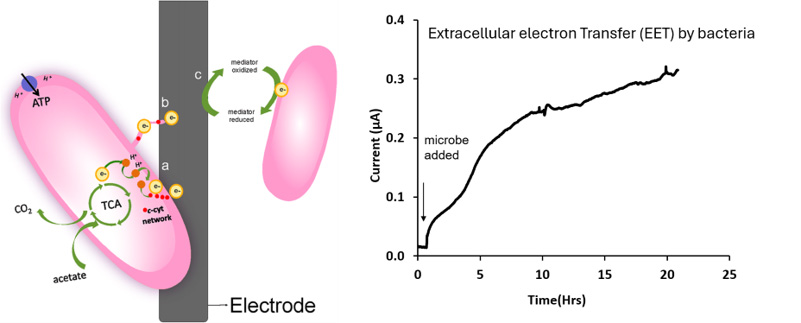
My research focuses on microbial electrochemistry, particularly extracellular electron transfer (EET), where electrons are transferred from inside to outside of bacteria to an external electron acceptor (Metal oxides) in anaerobic conditions, to develop sustainable solutions for energy, environment, and health. I investigated how microorganisms exchange electrons with their surroundings and apply this knowledge to bioelectrochemical systems for carbon conversion, bioremediation, and resource recovery. My previous research established that oral and gut pathogens can perform extracellular electron transfer (EET). This includes organisms such as Streptococcus mutans, Corynebacterium matruchotii, and Capnocytophaga ochracea, where electron transfer is directly linked to metabolism, biofilm activity, and disease progression. Bacteria can utilize EET coupled Iron (Fe3+ to Fe2+) reduction to generate reactive oxygen species (ROS) via Fenton reaction to damage the tissue leading to inflammation and progressing human diseases.
Research Theme
Shewanella based Bioelectrochemical Systems
At the University of Toyama, I focus on developing bioelectrochemical reactors that convert CO2 into methane using EET. Shewanella at the anode transfers electrons to methanogens at the cathode, enabling sustainable methane production under mild conditions. I work with model organisms such as Shewanella oneidensis to understand electron transfer pathways, including cytochromes and flavin-mediated transport, forming the basis of advanced bioelectrochemical systems.
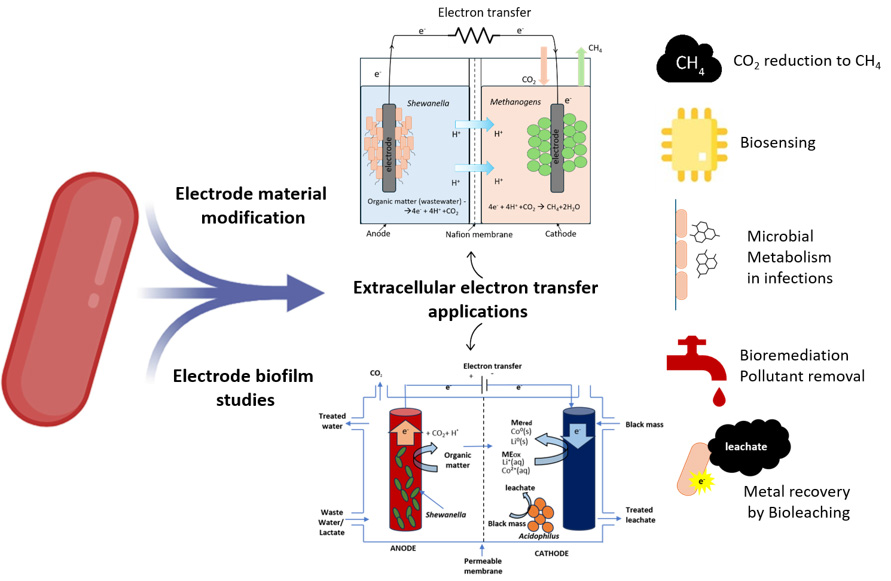
My research is grounded in extracellular electron transfer (EET), which serves as a fundamental framework for investigating and optimizing bioelectrochemical systems. I focus on electrode material modification to enhance microbe–electrode interactions and improve electron transfer efficiency. In parallel, I study electrode-associated biofilms to understand microbial community behavior and their role in system performance. I also extend EET concepts to investigate biofilm formation and infection mechanisms in human pathogens, providing insights into clinically relevant processes. Based on these integrated studies, I design and develop advanced bioreactors for applications such as wastewater treatment, resource recovery, and methane (CH4) production. Overall, my work combines EET-driven microbial processes with innovative reactor engineering to address environmental and biomedical challenges.
Research Vision
My research aims to integrate microbiology, electrochemistry, and materials science to develop next generation bioelectrochemical systems for carbon neutrality, climate change mitigation, and sustainable environmental technologies.
Selected Publications
- • Takano, S., Takenawa, S., Naradasu D., Yan, K., Wen Xin, X., Maehara, T., Nomura, N., Obana, N., Toyofuku, M., Usui, M., Ariyoshi, W., Okamoto. A., Enrichment of Horizontally Transferred Gene Clusters in Bacterial Extracellular Vesicles via Non-Lytic Mechanisms. The ISME Journal, wraf193 (2025). PMID: 40879164.
- • Naradasu, D†.; Miran, W†.; Okamoto, A. Electrochemical Characterization of Two Gut Microbial Strains Cooperatively Promoting Multiple Sclerosis Pathogenesis. Microorganisms 12, 257 (2024). https://doi.org/10.3390/microorganisms12020257. † Equal authors.
- • Naradasu D†., Miran W†., Sharma S†., Takenawa S., Soma T., Nomura N., Toyofuku M., and Okamoto A*, Biogenesis of Outer Membrane Vesicles Concentrates the Unsaturated Fatty Acid of Phosphatidylinositol in Capnocytophaga ochracea. Frontiers in Microbiology, 12, 682685. (2021), doi:10.3389/fmicb.2021.682685. † Equal authors
- • Naradasu D., Guionet A., Miran W. and Okamoto A*. Microbial current production from Streptococcus mutans correlates with biofilm metabolic activity. Biosensors and Bioelectronics 162, 112236, (2020), doi: 10.1016/j.bios.2020.112236.
- • Naradasu D., Guionet A., Okinaga T., Nishihara T., and Okamoto A*. Electrochemical Characterization of Current‐Producing Human Oral Pathogens by Whole‐Cell Electrochemistry. ChemElectroChem 7, 2012-2019, (2020), doi:10.1002/celc. 202000117. This work is published as a cover image in ChemElectroChem.
- • Naradasu, D., Miran, W., Sakamoto, M., & Okamoto, A. Isolation and Characterization of Human Gut Bacteria Capable of Extracellular Electron Transport by Electrochemical Techniques. Frontiers in Microbiology 9, 3267, doi:10.3389/fmicb.2018.03267 (2018).
- • Miran, W., * Naradasu, D., & Okamoto, A., “Pathogens Electrogenicity as a Tool for In-Situ Metabolic Activity Monitoring and Drug Assessment in Biofilms” iScience 24, 102068. DOI: https://doi.org/10.1016/j.isci.2021.102068 (2021). * Equal authors