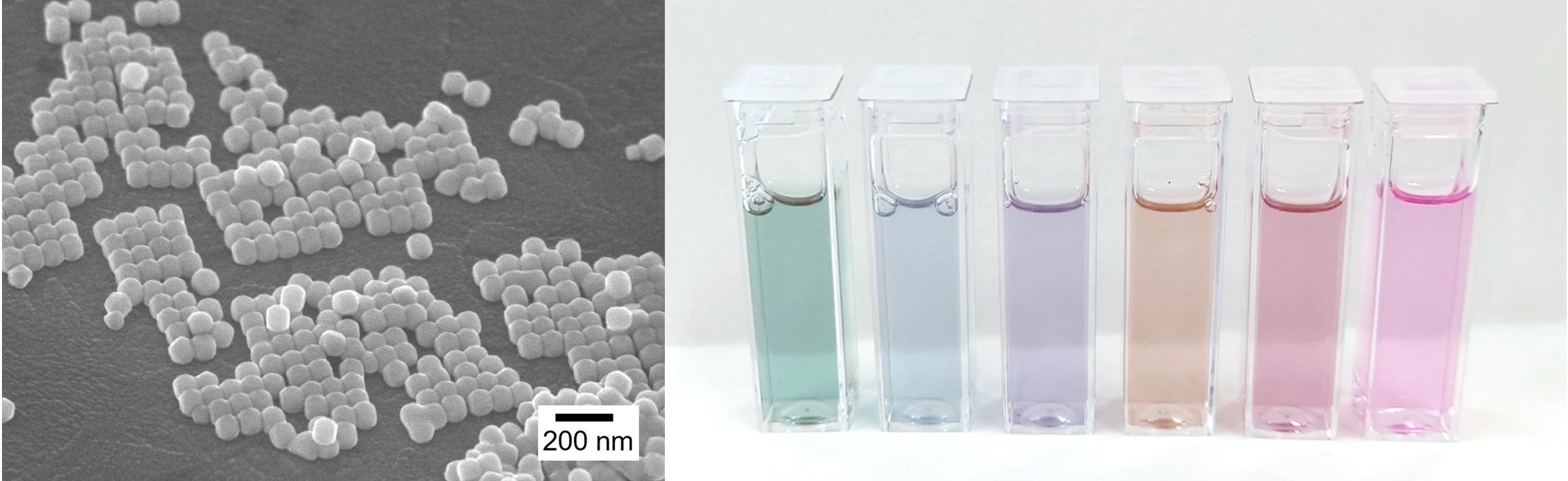
Nanometer-scale particles (nanoparticles) and fine structures (nanostructures)
exhibit unique optical properties that differ significantly from those
of materials at the macroscopic scale familiar to us in everyday life.
For example, when we think of gold (Au), we typically imagine gold medals
or bullion. However, when gold is structured into nanoparticles, it strongly
absorbs light in the visible to near-infrared region due to a phenomenon
known as localized surface plasmon resonance (LSPR).
The optical properties of such nanomaterials are governed not only by
the size and shape of individual particles, but also by their arrangement,
such as interparticle distance and periodicity, as well as by combinations
of different nanostructures. Therefore, the ability to “create nanostructures
as designed” is key to unlocking their functions and developing new applications.
Guided by our motto, “Creating designed nanostructures through the power of chemistry and light
to unlock their functions,” our laboratory aims to develop novel fabrication methods and discover
new optical functionalities by integrating chemical synthesis with photoelectrochemical
approaches.
1. Light-driven fabrication of nanostructures
Redox reactions driven by light are known as photoelectrochemical reactions,
in which materials can be deposited or dissolved simply by light irradiation.
In our research, we aim to fabricate well-controlled nanostructures by
precisely controlling where these photoelectrochemical reactions occur.
This is achieved by designing the shape of the substrate and optimizing
the way light is irradiated.
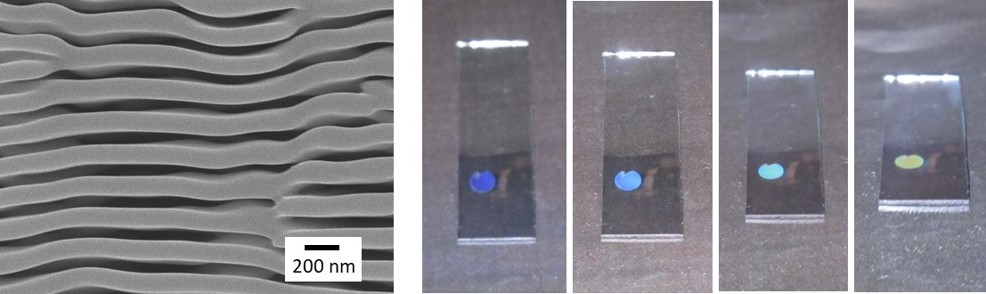
For example, when linearly polarized light is applied to a transparent
electrode to drive a photoinduced oxidative deposition process, periodic
nanostructures are formed along the polarization direction, as shown below
(ACS Appl. Nano Mater., 7, 5426-5433 (2024)). Because this approach enables the simple and large-area
fabrication of controlled nanostructures using only light, we are working
to expand the range of applicable materials and nanostructures.
2. Light-driven processing of nanoparticles
Because light cannot generally be focused to dimensions smaller than its
wavelength, it is difficult to achieve nanometer-scale processing using
light alone. In contrast, nanoparticles exhibiting plasmon resonance can
confine light within a region of only a few tens of nanometers near their
surface. Taking advantage of this property, we investigate methods for
processing nanoparticles by driving nanoscale photoelectrochemical reactions
at specific sites on their surfaces.
For example, as shown below, when green light is irradiated onto cubic
gold nanoparticles (gold nanocubes) to induce oxidative deposition or dissolution,
the reaction occurs only on the top face of the nanocubes. In contrast,
when red light is used to drive the same reactions, they occur selectively
near the interface between the nanocubes and the electrode. In this way,
different nanostructures can be selectively fabricated by simply changing
the irradiation wavelength (Nanoscale, 11, 19455-19461 (2019)). Currently, we are working to expand the range of
applicable reactions, improve site selectivity, and enhance the functionality
of nanoparticles through such processing techniques.
3. Exploiting surface oxidation of gold
Gold is generally regarded as a chemically stable metal that does not
readily oxidize. However, in electrochemical and photoelectrochemical systems,
surface oxidation of gold can occur when a positive (noble) potential is
applied or when gold nanoparticles absorb light. The resulting gold oxide
layer is extremely thin, typically on the sub-nanometer to nanometer scale.
As a result, even when the surface of plasmonic gold nanoparticles is oxidized,
their optical properties do not usually change significantly.
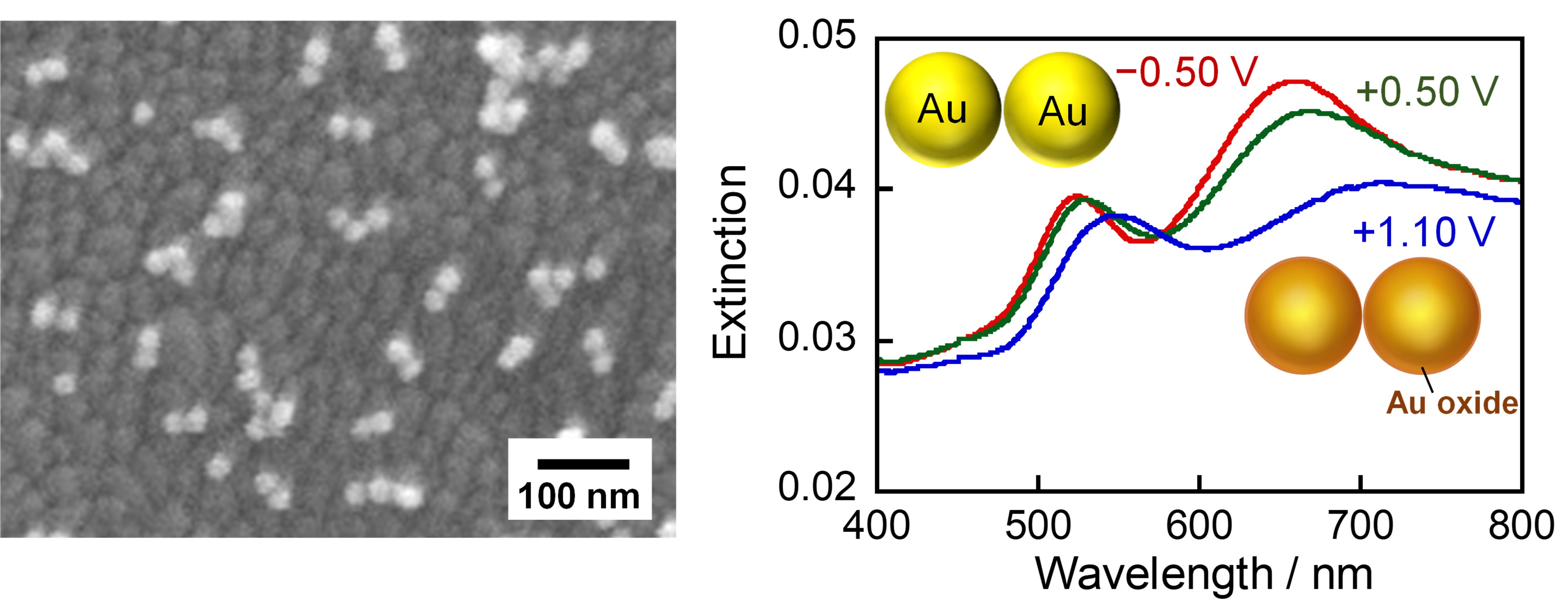
However, as shown below, when gold nanoparticles are assembled into structures
where particles are closely spaced (but not in direct contact), we have
found that surface oxidation can induce a remarkably large and reversible
change in optical absorption (Chem. Commun., 60, 7870-7873 (2024)). This represents a clear example of “creating designed
nanostructures to unlock their functions.” In this way, our research explores
the use of gold surface oxidation, an effect that has received relatively
little attention, to develop new functional nanomaterials.